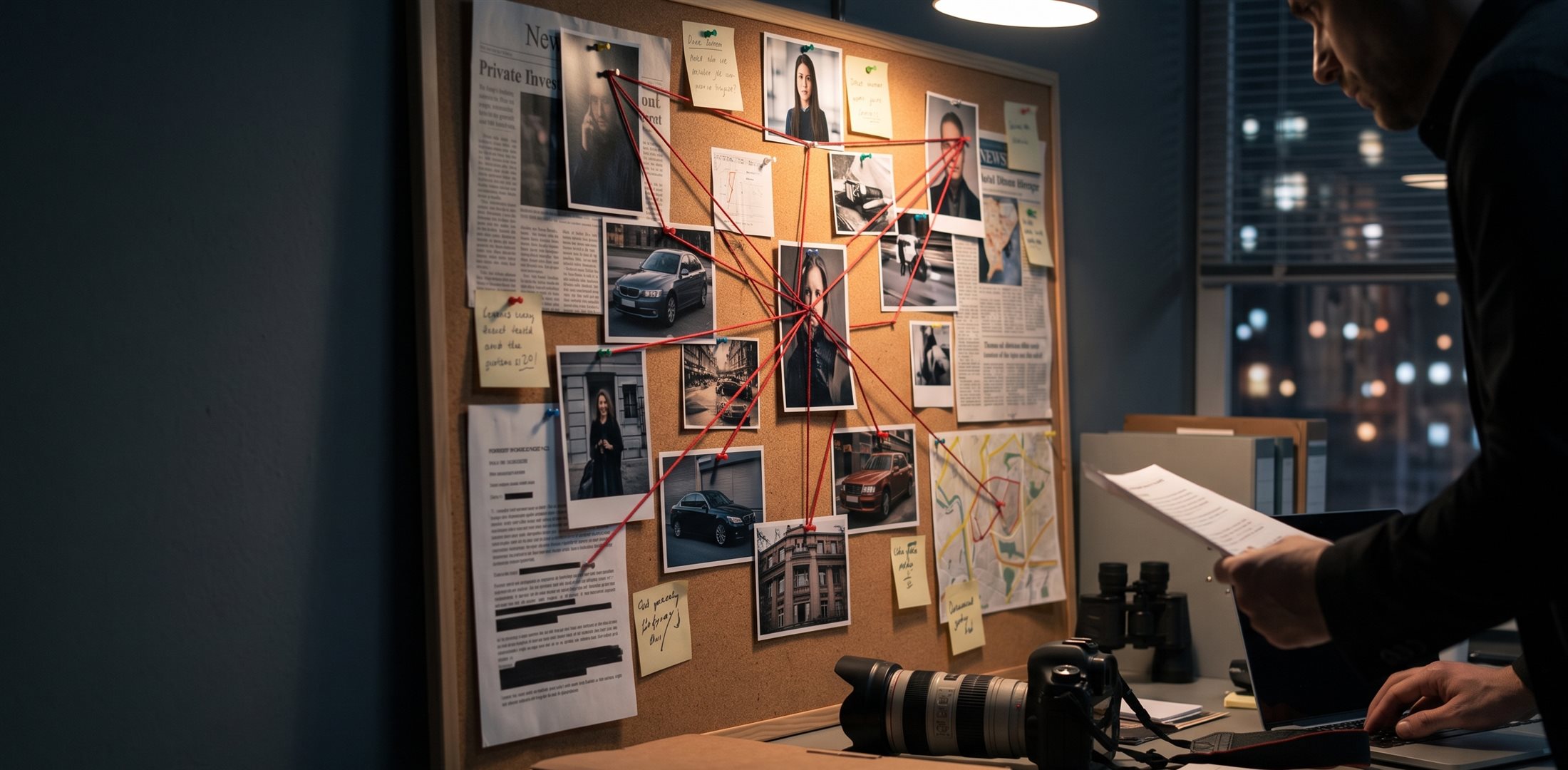
A buyer always favours one vendor
Quotations are collected, yet the same supplier wins each time at a price nobody can explain. You want to know whether the purchase officer has a private arrangement with that firm.

This is an enquiry into one employee you no longer trust. It is for owners, HR heads and department managers who suspect kickbacks, a side business run on company time, inflated claims or a second job, and who want facts before they act.
A cheating employee enquiry looks at the conduct of one named person on your payroll. Unlike a wider espionage or fraud review, it starts and ends with that individual: where he goes during working hours, who he meets, whether he holds an interest in a supplier, whether a second job or a private firm sits behind his absences, and whether the claims and approvals in his name match what actually happened.
Dishonesty by a trusted member of staff is hard to raise without proof. Confront too early and the person resigns, deletes what he can and tells colleagues he was accused unfairly. Wait too long and the losses grow. Most employers also face a practical problem: the suspicion comes from a colleague’s remark or an odd figure, which is not enough for a show-cause notice or a disciplinary hearing.
An outside investigator removes that difficulty. We work on the subject without involving his team, so office gossip does not warn him. You receive a dated account of what was observed, supported by photographs or video where relevant, and copies of what we lawfully obtained. With that in hand your HR and legal teams can decide on a warning, a hearing, a recovery or a police complaint.
Few employers ring us on the first suspicion. These are the situations where managers in Mumbai, Navi Mumbai and Thane decide the question has to be settled properly.
Quotations are collected, yet the same supplier wins each time at a price nobody can explain. You want to know whether the purchase officer has a private arrangement with that firm.
A sales or service engineer reports visits that customers do not remember. Call logs and claim forms look tidy, but the day cannot be accounted for and targets keep slipping.
A manager leaves suddenly and a rival launches a similar offer within weeks. You want to know what he was doing in his last few months with you.
Hotel bills, fuel and client entertainment rise while business falls. The paperwork is complete, so you need to know whether the journeys and meetings took place at all.
Material, scrap or finished goods go missing in small amounts at a warehouse or site. Audit finds the shortfall but not the person moving it out.
A colleague reports that someone is running his own firm, or asking customers for money on the side. The allegation is serious and cannot be acted on unverified.
We keep the circle small and the enquiry narrow, so the subject carries on as usual and your staff have no reason to believe anyone is being watched.
You tell us who the employee is, what you suspect and what first raised it. We ask for his role, working pattern and territory, and agree who inside your company knows about the enquiry.
We put in writing what will be checked and over what period, and confirm your authority as the employer for work on your own premises, staff and records.
Our investigators follow the subject’s working day in public places: where he goes, how long he stays, whom he meets and whether the visits match his reports.
We look for a company or firm in his name or a relative’s, and for links between him and the suppliers he deals with, using public registers and market enquiry.
You receive a written report with dates, places, photographs or video where available, and our findings set out plainly. We then talk you through what it does and does not establish.
Our method is observation and enquiry, not intrusion. We watch the subject in public and semi-public places, speak to people in the market as ordinary enquirers, and read what is openly on record. We do not touch your employee’s phone, personal accounts or private messages, and we do not ask you to hand us anything you are not entitled to hold. That line protects your company as much as it protects us.
Confidentiality works in both directions. Your name is not disclosed to anyone we speak to, and our field investigators are not told why the subject matters to you. Reports go only to the person who briefed us, by email, post or collection from our Vashi office. Nothing is shared with any other party without your instruction or a court order, and we never discuss one client’s case with another.
The enquiry stays on the named employee. We do not widen it to his colleagues or his family without your instruction and a reason.
No one visits your office, no questions are asked of staff, and nothing we do gives the subject cause to suspect an enquiry.
Public registers, market enquiry, open records and surveillance in public places, with your written authority for anything on company premises.
We report what was seen and what was verified. Where something remains unproven, the report says so rather than filling the gap.
We have handled internal conduct cases for companies and banks for over a decade, and we know how quietly they have to be run.
Our head office at Platinum Techno Park in Vashi sits near the companies we work for, and our investigators cover Mumbai’s business districts.
Written findings, dated, with photographs or video where relevant, in a form your HR and legal teams can put before a hearing or a committee.
HR and legal teams brief us themselves and deal with the same people throughout, so nothing about the case passes through extra hands.
Yes. An employer may make reasonable enquiries about an employee’s conduct at work, and surveillance in public places does not require his knowledge. What we will not do is enter his home, open his personal accounts or intercept his calls. For anything on your premises, including your own records and systems, we work on your written authority.
It depends on the behaviour and how often it occurs. A side business or a second job often shows within one to two weeks of observation. Vendor kickbacks can take longer, because the link has to be traced through market enquiry and open records. We give you a realistic time frame at the briefing, before any work begins.
That decision is yours and your lawyers'. We document what was observed and verified, with dates and supporting photographs or video where available, so the material can support a show-cause notice, a disciplinary hearing or an internal decision. We cannot promise any particular outcome, and we never state that a finding will be accepted elsewhere.
We report that too. A clean result is a useful answer: it ends a doubt that was affecting how you manage the person, and it stops an unsafe accusation. We will tell you plainly what was looked at, over what period, and what we could not establish, rather than stretching thin observations into a conclusion.
We plan each case so that he does not. No one from our team comes to your office unless you ask, we do not question your other staff, and field work is done at a distance in public places. Your name is never mentioned to anyone we speak to during market enquiry.
The first case evaluation is free. Call 1800 120 2464, send a message on WhatsApp to +91 99878 22404, write to info@metroindiadetective.com, or come to our Vashi office. Tell us who the employee is and what you have noticed, and we will say what can realistically be established.
Talk to us in confidence before you raise it with him. Tell us what you have noticed and we will explain what an enquiry can establish, how long it should take and what the report will contain.